
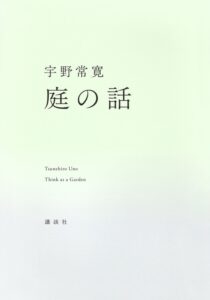
Tsunehiro Uno宇野常寛
Tokyo: Kodansha, 2024.
Reviewed by: Jinjin Zhang (PhD Candidate, The Chinese University of Hong Kong)
How can we respond to the increasingly enclosed, platform-driven global capitalism? Media professional and social critic Tsunehiro Uno offers a compelling answer: “Think as a garden.” In his work, framed as a “theory of the information society,” Uno blends concrete social design cases with philosophical critique to seek new possibilities for human society beyond dominant social media logic. He posits that contemporary society operates within a “market-game” framework, where platform architects extract profit by inflaming the human desire for mutual recognition. This system fans global fragmentation, xenophobia, and the populist erosion of democracy. To beat a retreat, Uno presses for a move from purely human-centric interaction to an ecosystem focused on relationships between humans and non-human things.
The niwa (garden) is his central metaphor for this gesture. It represents a social mechanism where individuals maintain independence while interacting in ways distinct from platform logic. Uno likens platforms to dark, barren, and biodiversity-poor forests, in contrast to a niwa as a cultivated yet semi-open space where humans place rocks, spread sand, adapt to climate and the intervention of plants, insects, birds, and animals. This fosters symbiotic communication among different species and their subjective worlds (Umwelten), akin to the “insect-flower” relationship noted by thinker Munesuke Mita. Uno’s vision draws inspiration from French gardener Gilles Clément’s “third landscape,” a fluid, high-biodiversity space between wild forest and cultivated farmland, like wet lands and rocky fields. The gardener’s role, then, is one of continuous, observant intervention in the everyday (ke), nurturing diversity without grand revolutionary designs in “traffic spaces” (kōtsū kūkan), like community centers, public baths, and cafés. This is a politics of subtle, conscious cultivation within daily life.
However, Uno does not embrace the post-Fukushima mainstream Japanese trend of returning to community (kyōdōtai), whether rural villages, religious groups, fan clubs, or friend associations. Communities, he argues, revolve around what Karatani Kōjin calls “context” or Wittgenstein’s “language-games,” which inevitably erect boundaries and hierarchies of insider/outsider, allies/enemies. Both left and right, in seeking to rebuild an “absolute home” extending to the hometown and nation-state, are complicit with platform logic. The conspicuous shift from market-based exchange to “empathy”-based gift networks and sharing economies is often packaged as “sustainable development” within capitalist introspection. These often mask intensified surveillance, from the quantified competition of Google Maps ratings to China’s social credit system, not to mention the blockchain-based irreversable visualization of social capital doubling layers of constraint. True freedom, for Uno, entails departing from what Yoshimoto Takaaki called the “collective illusions” of nation and religion and the “secondary illusions” of family, toward a “fragile autonomy.” This autonomy indicates shifting from being an online influencer seeking status to becoming a “nobody” who addresses itself to doing, or Hannah Arendt’s “work,” and cultivates the “beauty of unconscious making” championed a century ago by Sōetsu Yanagi’s folk crafts and life philosophy movement.
Readers interested in digital society, media studies, and sociotechnical visions will appreciate Uno’s poetic, layered analysis built on his earlier works The Age of Little People and Slow Internet. However, his niwa conceptualization does not address the intersection between the “real space” and “cyberspace.” Uno’s aversion to rural communal bonds also renders his perspective urban-centric. Nonetheless, this “humanities-driven” project exemplifies an updated intellectual response to global platform capitalism and shifting geopolitical orders in hope of greater freedom, justice, and empowerment. Uno’s vision stands as one available ideal, yet the deeper question of whom these gardens serve quietly awaits more devoted “gardeners” to cultivate their flourishing.