
Alumni Publication Q&A: “An Islam-Driven History of China”
Publication News
March 11, 2026
A discussion with former HYI Visiting Fellow Noriko Unno-Yamazaki about her recent publication イスラームが動かした中国史:唐宋代から鄭和の大航海、現代回族まで (An Islam-Driven History of China: From the Tang-Song Period to Zhenghe's Voyage to the Contemporary Hui Nationality)
 Noriko Unno-Yamazaki will be an Associate Professor at the Institute for Research in Humanities at Kyoto University starting in April 2026. She was a HYI Visiting Fellow from 2015-16.
The book was published by 中央公論新社 (Chuo Koron Shinsha), December 2025. For more information (in Japanese), visit the publisher’s website.
What is your book about?
 This book offers a comprehensive history of Muslims in China, focusing primarily on the group known today as the Hui. Written for a general academic audience, it explores how Muslim migrants from West, Central, and Southeast Asia—and their descendants—navigated their relationship with Chinese civilization and reshaped its social fabric. Since the initial encounter between Islam and China in the seventh century, Muslims have served as vital catalysts for the advancement of successive dynasties. From the so-called Silk Road trade of the Tang and Song eras to the Mongol Empire, the voyages of Zheng He, the Qing-era rebellions, the Xinhai Revolution, the Sino-Japanese War, and the modern crisis in Xinjiang, this work unpacks a 1,400-year trajectory of entangled interactions through the lens of global history.
A central theme is the complex formation of Muslim identities. The Hui are descendants of early Muslim migrants who intermingled with local populations across Eastern Eurasia, including Han Chinese and Mongols. While they speak Chinese today and often resemble the Han majority, their status as a distinct “nationality” (minzu) was formalized in the 1930s and 40s, when the Chinese Communist Party promised them autonomy to secure their cooperation during the anti-Japanese resistance and the subsequent Civil War. In contrast, the Uyghurs are a Turkic people with roots in Central Asia who maintain a unique language and oasis culture. Their modern ethnic identity solidified during the political upheavals in China and the Soviet Union in the first half of the 20th century, following the mid-18th-century integration of East Turkestan into the Qing Empire’s “New Frontier” (Xinjiang).

Qingjing Mosque (Source: Official website of the Quanzhou Municipal People’s Government website)
Crucially, this book challenges the academic tendency to study these groups in isolation. While modern state-led classifications often draw sharp lines between them, history reveals a much more fluid reality of shared religious networks and political tensions. By examining these historical interactions, this work provides the essential context needed to understand the complex ethnic and religious issues shaping Eastern Eurasia today.
What inspired you to start writing on this topic?

An imperial tablet that was mandated to be installed in mosques in the Qing period (Marshall Broomhall, Islam in China, p. 228)
My research is driven by a need to re-evaluate the history of Muslims in China as a vital model for multicultural coexistence. While Islam is often stereotyped as an “inflexible” or “violent” faith, its 1,400-year trajectory in China reveals a remarkable adaptability. Through a profound dialogue with Chinese traditions, including Confucian morality, Islam took root and evolved into a unique expression of the faith that is both authentically Islamic and distinctly Chinese.
Even some specialists in Chinese history perceive the Hui merely as “Sinicized” Muslims, characterizing their history as one of unidirectional assimilation. However, as I demonstrate, Muslims actively contributed to the development of Chinese society by introducing advanced knowledge in fields such as astronomy, medicine, and military technology. I argue that these contributions enriched the culture to such an extent that the phenomenon could be described as the “Islamization of China.” By highlighting these influences, we can challenge the reductive narrative of “assimilation,” de-center the Han-centric view of history, and recognize China’s deep, historical integration into the broader Eurasian world.

Opening ceremony of a modern school for Muslims (“Dâr’ül-Ulûmi’l-Hamidiyye,” House of Knowledge of Hamid) in Beijing, 1908 (Courtesy of Mr. Zhang Juling)
This project also addresses the current political climate. Since the late 2010s, the Chinese government has pushed for a “Sinicization of Religion” policy aimed at aligning religious practices more strictly with state ideology. From an academic standpoint, reducing this entangled history to “Sinicized Islam” risks uncritically validating such political narratives. I aim to show that the journey of Muslims in China was not about Islam being swallowed by Chinese society, but a dynamic, reciprocal exchange where both civilizations mutually elevated one another. Ultimately, the resilience of Muslims in China offers essential wisdom for pluralism and integration in the modern world.
Can you describe a surprising or unexpected finding?
Previous studies have primarily emphasized the Hui people’s ties to the Arab world and the Persian traditions within their religious education. While these remain vital to their identity, the process of writing this book led me to a more unexpected realization: the complex relationship—marked by both friction and collaboration—between the Hui and the Turkic Muslims of East Turkestan played a far more pivotal and reciprocal role than previously understood.
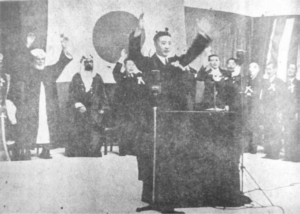
Aisin Gioro Pukuang shouting “Tenno Heika Banzai” (Long Live the Emperor) at the inauguration ceremony of the Tokyo Mosque
in 1938 (Published in Zhenzongbao Yuekan)
It was also fascinating to trace how modern Hui educational reform was heavily inspired by a broader transnational Muslim world, including the Ottoman and Russian Empires. At the same time, I confirmed the profoundly disruptive influence of Imperial Japan, which sought to exploit the Hui for its own colonial gains, thereby plunging Hui society into a state of deep instability. These findings led me to a central conclusion: the history of Muslims in China is best understood not as a localized phenomenon, but through a dynamic web of interactions maintained both internally across China and globally across Eurasia.
What are you working on next?
Moving forward, I am exploring the socio-cultural history of the Hui with a particular focus on their foodways. Dietary habits have played a crucial role in the construction of their unique identity and their ongoing negotiations with various groups both within and outside China. By examining the evolution of the concept of “qingzhen” (halal), the influx of culinary techniques from the broader Islamic world, and the environmental contexts of food supply, my research diachronically illustrates the multifaceted cultural exchanges centered on Muslim cuisine.
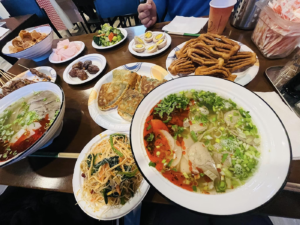
At a halal Chinese restaurant in New York, 2024
This scope extends to ethnographic fieldwork on the transformation of food cultures in traditional Chinese Muslim societies across Central and Southeast Asia, as well as in contemporary Hui communities in Japan and the West. Through this lens, I aim to show how “the plate” serves as a site of both cultural preservation and dynamic adaptation in the face of migration and modernization.
Furthermore, I am launching a project on the history and culture of the Dungan people—the descendants of Hui Muslims who fled to Russian Central Asia following the late 19th-century Muslim rebellions in Northwest China.
A key focus of this research is the Soviet “National Delimitation” process of the 1920s. I examine how the Dungan people strategically utilized Turkic languages to assert a shared identity with Turkic Muslims from East Turkestan, navigating the complex ethnic politics of the early USSR.
Additionally, I analyze the contemporary socio-economic tensions surrounding the Dungan community within the framework of China’s Belt and Road Initiative (BRI). My research explores how the economic gains acquired by Dungans through their roles as intermediaries in Chinese trade have fueled resentment among other Central Asian populations, in some cases escalating into tragic outbreaks of ethnic violence. By tracing these long-term shifts, I aim to provide a comprehensive understanding of the Dungan’s unique position at the intersection of Chinese, Russian, and Central Asian spheres of influence.
Related Stories
Publication News
Seventeenth Book in the NTU & HYI Academic Book Series publishedWednesday, December 17, 2025