
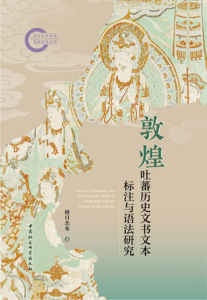
Geri Jiebu (Guru Kyab)
China Social Sciences Press, 2026
About the book: This volume is divided into two parts: textual annotation and grammatical analysis. The first part provides systematic grammatical annotations of six Dunhuang Old Tibetan historical documents—PT.1038, PT.1286, PT.1287, PT1288, ITJ.750, and Or.8212/187. The second part draws on these annotated texts to investigate a wide range of linguistic phenomena, including lexical categories, word formation, gender marking, diminutive and augmentative morphology, number marking, definiteness, case marking, nominalization, tense–aspect categories, modality, word order, grammatical relations, and the structure of both simple and complex sentences. Together, these studies offer a comprehensive description of the grammatical system of Dunhuang Old Tibetan and contribute to our understanding of the historical development of the Tibetan language.
The Dunhuang Old Tibetan historical documents are among the most important sources for the study of Old Tibetan. Composed between the eighth and eleventh centuries, they preserve linguistic features that closely reflect contemporary spoken Tibetan. Scholars commonly distinguish two major linguistic registers in Tibetan texts of this period: the language of Buddhist translations and a written style derived from vernacular usage. The documents examined in this volume belong to the latter category. Unlike Buddhist translation literature, they provide more direct evidence for the native grammatical structure of Old Tibetan and are therefore of particular value for historical linguistic research.
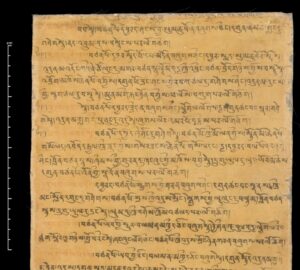
A Passage from a Dunhuang Old Tibetan Historical Document
Although many aspects of Old Tibetan grammar have been investigated, previous studies have often treated Buddhist translation texts and indigenous historical documents together, making it difficult to distinguish features attributable to translation practices from those reflecting ordinary language use. At the same time, the lack of systematically annotated corpora has limited the empirical foundation of grammatical research. To address these issues, the present study focuses on six well-known Dunhuang historical documents whose philological interpretation has been established through extensive previous scholarship. Through detailed grammatical annotation and morpho-syntactic analysis, the book provides a systematic description of the linguistic structures represented in these texts.
The annotated corpus assembled here offers a reliable foundation for future research on Old Tibetan grammar and contributes more broadly to the historical study of the Sino-Tibetan language family. As a language with relatively rich morphological marking and an early written tradition, Old Tibetan preserves evidence that is crucial for understanding the historical development of morpho-syntactic patterns across Sino-Tibetan languages. The linguistic features documented in the Dunhuang historical texts thus constitute an important source of comparative data from more than a millennium ago.
About the author: Geri Jiebu (Guru Kyab) was a HYI Visiting Scholar from 2025-26.