
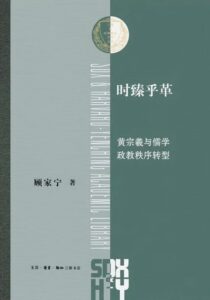
Jianing Gu 顾家宁
Beijing: Sanlian (SDX & Harvard-Yenching Academic Library), February 2026
This book explores Huang Zongxi’s complete intellectual framework, uniting his theories of mind-nature and state governance to reveal the inner link between morality and political order. He stressed practice and self-awareness in his philosophy of mind, fostering scholar-officials’ political agency. For institutional reform, he advocated core ideas: The realm is the subject, the ruler the object. His blueprints for academies, legal systems and ministerial power envisioned a post-imperial governance model beyond family-based autocracy. Systematic analysis shows his ideas addressed the quest for social order. Rather than overturning Confucianism, he re-examined and revitalized the tradition amid contemporary crises.
本书从黄宗羲完整的学术世界出发,统摄其心性之学与外王之学两个维度,揭示他如何在道德与政治秩序之间建立内在贯通。在心性层面,黄宗羲强调实践与自得,发扬心学自主精神,并将其转化为士人政治主体性的精神根基;在制度构想上,他提出“天下为主,君为客”“有治法而后有治人”“公其非是于学校”等原理,以学校、治法、相权等一系列具体经世规划,勾勒出突破“家天下”逻辑、以士人主体为核心的“后帝制”新型政制结构。通过对这些思想的系统阐释与历史延展的考察,本书展示了黄宗羲如何回应“秩序重建”的时代命题,并揭示其思想并非是对儒学传统的颠覆,而更是一种在时代问题驱动下对传统的重思与再造。
About the series: The SDX and HYI Academic Series 三联·哈佛燕京学术丛书 began in 1994. It is edited by Feng Jinhong, Yang Le, and Zhong Yun, and is expected to publish 6 titles per year.