
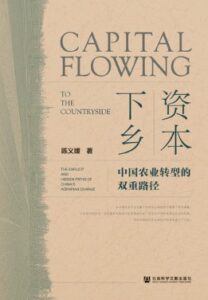
Chen Yiyuan 陈义媛
Beijing: Social Sciences Academic Press, 2020.
Reviewed by: Yijun Gai (PhD Candidate, University of Hong Kong and Southern University of Science and Technology)
Driven by decades of intensive industrial and commercial development, over-accumulated urban capital in China has found a new frontier for accumulation within the rural agricultural sector. Chen Yiyuan’s Capital Flowing to the Countryside: The Explicit and Hidden Paths of China’s Agrarian Change (《资本下乡:中国农业转型的双重路径》) offers a grounded exploration of this structural shift. By inquiring into the mechanisms driving this capital influx, Chen contributes a contemporary Chinese chapter to the classic agrarian concern regarding the survival of family farming within a rapidly capitalizing agricultural system.
Chen conceptualizes this capital penetration through a dual-path framework aimed at scaling up agricultural development. The “explicit path” entails visible large-scale land circulation facilitated by state actors, whereas the “hiddenpath” operates through the commercialization and monetization of upstream and downstream agricultural services, such as sowing, fertilizing, and harvesting, without altering land management rights. While the hidden path has quietly evolved since the dawn of China’s market reforms, the explicit path emerged more recently.
Through an in-depth empirical study of a leading “dragon-head” agribusiness in Hunan Province, Chen demonstrates how corporate vertical integration relies on concentrating and controlling land use rights to monopolize upstream input sales and downstream grain processing. This strategy depends heavily on local farmers operating as subcontracted agents (daili hu), who leverage their localized social networks to defuse conflicts generated by capital penetration and stabilize agricultural production. Intervening in the classic debate between Lenin and Chayanov on the survival of family farming, Chen argues that these seemingly independent family farmers have effectively been transformed into “disguised” contract laborers. Meanwhile, the ongoing specialization and technological appropriation of agricultural activities strip ordinary smallholders of their reproductive capacity, forcing them into the reliance on rural-to-urban labor migration.
This displacement is actively facilitated by state actors. Chen elucidates how, following the tax-sharing reform, the state-driven “project system (xiangmu zhi)” incentivizes local governments to collude with corporate actors to accumulate fiscal and political capital through administrative land transfers. However, Chen’s analysis of the state remains truncated. While she flags overcapacity issues in the agri-chemical and machinery industries and notes the role of state in their rural proliferation, Chen potentially overlooks how the state, without fully considering localized needs, unloads its enthusiasm for agricultural industrialization and its mandate to absorb industrial overcapacity onto the countryside.
This analytical limitation compromises Chen’s concluding proposal. To shield smallholders from corporate exploitation, she proposes an organizational model for peasants that mimics the “state reclamation (nongken)” system, combining top-down state coordination with decentralized household operations. This recommendation is inherently risky: it substitutes corporate hegemony with bureaucratic authority, continuing the imposition of external mandates to override local realities. An alternative lies in strengthening bottom-up rural self-governance. Although self-governance remains challenging, rebuilding horizontal solidarity and collective bargaining capacity remains a crucial structural approach to break the dependency cycle on corporate capital and bureaucratic mandates.