
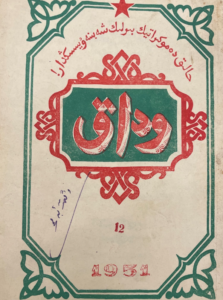
Summary written by Ben Hales, PhD student, History and East Asian Languages.
Publisher: Shinjang tinchliq we khelqchilliq himaye qilish ittifaq 新疆和平民主同盟
Location: Ghulja/Yining (1948-1950), Dihua (1950-1954)
Language: Uyghur and Kazakh, depending on edition
Authors: Ittifaq zhurnili tehrir hey’iti
The Union (Ittifaq in Uyghur, Odaq in Kazakh) testifies in print to the turbulence of mid-20th century Xinjiang. Published in Uyghur and Kazakh, this monthly journal was the official political outlet of the Union for The Defence of Peace and Democracy in Xinjiang (UFDPD). Established in 1948, the UFDPD played a key role in Xinjiang as the Leninist ruling party of the late East Turkestan Republic (Sherqiy Türkistan Jumhuriyiti, 1944-1949, ETR) and the political vehicle of its second leader, Ehmetjan Qasimi (1914-1949). Fascinatingly, the journal continued publication past 1949, when the ETR was absorbed into the PRC and UFDPD became a short-lived Chinese Communist Party-aligned ‘democratic party’ (民主黨). The journal ceased publication in 1954, when UFDPD dissolved. Crossing the so-called ‘1949 divide’, Union is a rich resource on the politics of Uyghur and Kazakh political organizing in the mid-20th century, and of the transition to PRC rule. While issues of this journal have circulated among the Uyghur diaspora, Harvard is the first university known to have acquired copies.[1]
Understanding the importance of Union requires a brief description of the East Turkestan Republic itself.
In November 1944, revolution came to northwest Xinjiang’s Ili Valley. Coordinating with an underground movement centred in Ghulja (Yining), Ili Prefecture’s capital, expanding groups of primarily Uyghur and Kazakh partisans armed and equipped by Soviet advisors instigated a popular uprising against Chinese rule. On November 12, 1944, rebels in Ghulja declared a state, the East Turkestan Republic (ETR), eleven years to the day from the proclamation of a similar East Turkestan Republic (1933-1934) in the southern Xinjiang city of Kashgar.
In the six months following the ‘November Revolution’ the ETR’s army drove Chinese Nationalist Party (中國國民黨, Guomindang, GMD) forces entirely out of Ili’s neighbouring Tarbaghatay and Altay Prefectures. In September 1945, with its armies closing in on the provincial capital of Ürümchi, ETR expansion was abruptly halted when a telegram from Soviet leader Joseph Stalin paused its armies at the banks of the Manas River. Under Soviet pressure, both the ETR and GMD negotiated a coalition government to jointly rule Xinjiang. A shotgun wedding few on either side welcomed, this coalition collapsed in August 1947, leaving the Manas River as a state border between the ETR (now officially the ‘Ili Governing Council’) and the remainder of Chinese-controlled Xinjiang. The ETR-GMD frozen conflict survived into 1949, when Soviet pressure and the likely-engineered death of most of the ETR’s top leadership in a plane crash pushed the republic’s surviving leaders to accept complete annexation into the newborn People’s Republic of China.
The history of the ETR continues to be a political live wire.
As a multi-ethnic but heavily Uyghur state which articulated a pro-Soviet anti-colonial (that is an opposition to Chinese colonialism) politics of national liberation, the ETR is of paramount interest to Uyghur nationalists as the most successful example of 20th century Uyghur self-determination. A state which worked to integrate (with significant success) not only Uyghurs and Kazakhs but also Mongols, Sibe, Hui, Han Chinese and others under one banner, it is also a potentially subversive example of ‘ethnic unity’ in the region prior to Communist rule and in opposition to, not as a part of, China.
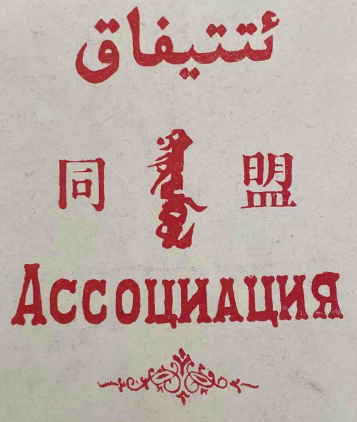
The back cover of the December 1951 Kazakh edition. Under the ETR, it was standard for the back cover of Union to display the magazine’s name in Uyghur/Kazakh, and the East Turkestan Republic’s other primary languages; Russian, Mongolian and Chinese. This was very likely an effort to underline UFDPD’s self-representation as a party representing all ethnicities under ETR control, even if the magazine itself was only published in the state’s dominant and governing languages.
For some, the ETR is also a story of Soviet subversion. Heavily supported with economic aid, advisors and at time troops by the USSR, the extent of Soviet control of the ETR and Soviet intent to use it to ‘split China’ remain highly political in Sino-Soviet and even contemporary Sino-Russian relations. As a result, barring a brief opening in the 1990s, Soviet and post-Soviet archives on the USSR’s activities in 1940s Xinjiang remain sealed.
After 1949, the ETR was meanwhile annexed by the PRC. Soviet-friendly and at least socialist-adjacent, former ETR officials proved a vital asset to an early Maoist state which lacked basically any Uyghur or Kazakh-speaking cadres in 1949. To coopt this group of valuable potential allies, the republic’s nature had to be officially sanitized and incorporated into the broader story of the Chinese Revolution, and so was rebranded in PRC propaganda as a patriotic ‘Three Districts Revolution’ (三区革命) against Guomindang oppression. This incorporation has never been comfortable. Later in the Mao era, ETR leaders who remained in China were heavily persecuted during the Anti-Rightist Campaign (1957) and Cultural Revolution (1966-1976). While the 1980-1990s saw a brief boom in memorial literature and official accounts of the period, by the 2000s the ETR’s continued subversive potential as a Uyghur nationalist symbol hhad rendered it extremely politically sensitive to work on in China. Since 2017, almost all official references to the ETR and previously accepted publications on the topic have been censored and most public monuments demolished. It goes without saying that the ETR’s own archives in Ghulja remain completely inaccessible at present.
The Union magazine itself shines a light on all of the above topics.
Harvard’s collection consists of seven copies of the magazine (six in Kazakh, one in Uyghur), from 1950-1954. They therefore date directly to a period when ETR elites and PRC cadres were negotiating on how to ‘fit’ the ETR into a new China. Early issues of the journal are extremely long, with 1950.2/3 running to over 200 pages, as befits the importance of the flagship journal of a major political party. Over the 1950s, as ETR elites increasingly became CCP members, the UFDPD declined. Its journal therefore shrunk, with our final edition (January 1954) running to a scarce 70 pages.
In terms of function, Union resembled a Soviet cadre study journal, bolted together with a ‘thick journal’ of the Soviet literary intelligentsia.
Politically, as an official journal designed for UFDPD cadre study sessions, the magazine carries copies of UFDPD leader speeches and top political directives. Our Harvard post-1949 copies also contain translated Chinese discussions on ethnic policy and China-wide priorities, which increasingly ‘squeeze out’ indigenous content as the 1950s proceed. This material effectively signalled the direct policy ‘line’ which the UFDPD wished its cadres to know about or actively enact at any given time. In the absence of accessible ETR archives, it is therefore an invaluable source on UFDPD’s political direction, bureaucracy, and information transmission.
The second function of the journal was literary. 1950 and 1951 (but seemingly not 1953 or 1954) editions of Union contained a major literary section, consisting of serialized prose, poetry and other verse alongside extended discussions of literary theory and national culture. Readers of this section will notice Uyghur and Kazakhs who went onto determine the shape of Uyghur and Kazakh official culture in Mao-era China.[2] They will also notice a significant volume of translated publications from Soviet authors, reflecting UFDPD’s Soviet connections. Across both literary and political segments, Union’s Soviet imitation is palpable. We can thus research it comparatively next to the Soviet informational production which inspired it, and of course next to PRC cadre and literary texts which, with their own twist, similarly imitated the ‘elder brother’ in Moscow. The presence of Union in Harvard Yenching Library testifies to the University’s persistence as a centre for the study of Uyghur topics and Inner Asian interconnections from the premodern period to today.
The author would like to thank HYL librarians Annie Wang, Yuzhou Bai and Ma Xiao-He for their assistance with logistics and their work on the acquisition of these items.
[1] It is unknown whether any institution in China holds copies. If they did, the sensitivity of the subject matter would likely render them inaccessible to outside researchers.
[2] For more, see Joshua L. Freeman, ‘Print and Power in the Communist Borderlands: The Rise of Uyghur National Culture’ (PhD Thesis, Harvard, 2019), https://dash.harvard.edu/handle/1/42029533.