
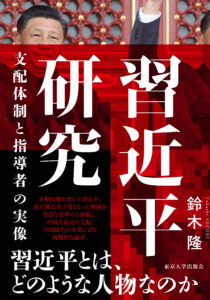
Takashi Suzuki 鈴木隆
Tokyo: University of Tokyo Press, 2025
Reviewed by: Yuki Mikiya (PhD Candidate, Keio University)
One influential framing of English-language debates on Xi Jinping contrasts Andrew Nathan’s account of norm-bound succession as a pillar of post-Mao “authoritarian resilience” with Susan Shirk’s description of a return to personalist rule. Suzuki’s book invites a different question: not whether Xi’s rule is personalist, but how a cadre formed by the Party acquired the repertoires, networks, and organizational leverage to personalize rule. Read this way, the book offers an account of the co-evolution of ruler and regime.
Part I, on the regime, is essential to that argument. Suzuki shows that Party recruitment shifted away from workers and peasants toward managers, professionals, and the highly educated, hollowing out the Party’s worker-peasant base even as its charter retained the language of a revolutionary vanguard. Developmental performance, nationalism, and digital-Leninist control help sustain the regime even as political freedom contracts. The Party appears not as a fixed constraint on Xi but as an organization whose constituencies, technologies of control, and legitimacy challenges are themselves changing. Part II therefore reads less as biography than as an inquiry into what kind of leader such a party-state helps to form.
Suzuki’s strongest contribution lies in his handling of sources. Rather than projecting the post-2012 ruler backward, he reconstructs Xi’s path from local newspapers, Party and government journals, and internally circulated materials produced during Xi’s various postings. He treats texts issued under Xi’s name as collaborative products of Xi and those around him, including speechwriters, superiors, and subordinates. He analyzes Xi as a relational actor constituted by his entourage, the cadre system, and the circumstances of each post. His diachronic reading of hexin (核心, “core”), lingxiu (领袖, “leader”), and douzheng (斗争, “struggle”), combined with his analysis of criticism and self-criticism in Party “democratic life” meetings and of the anticorruption campaign, shows how inherited repertoires organize loyalty and convert organizational authority into personal dominance.
Kevin Rudd emphasizes Xi’s Marxist-Leninist nationalist worldview, while Xu Chenggang stresses the system’s “institutional genes”; other studies foreground succession rules and elite coalitions. Suzuki’s distinctive contribution is to trace how a cadre was formed within local Party-state institutions and learned to mobilize their organizational resources. The contemporaneous official sources on which this reconstruction rests help guard against hindsight. They are strongest for reconstructing Xi’s institutional formation but less able to isolate his private preferences or intentions from collaborative drafting, strategic conformity, and biases in the surviving record.
For readers working mainly in English, Suzuki adds a detailed reconstruction of Xi’s pre-2012 political formation to a literature often centered on his national leadership after 2012. For scholars of Chinese politics, the book’s larger contribution is methodological as well as substantive. Its source-critical reconstruction shows how personalist rule can be assembled through Party institutions without either reducing Xi’s agency to structure or attributing institutional change to a single leader. It thereby connects leadership studies with a historically grounded analysis of how political actors are formed inside authoritarian organizations.