
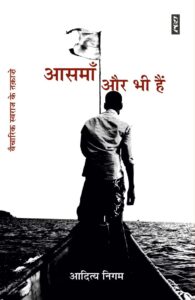
Aditya Nigam
Setu Prakashan Pvt. Ltd., 2023.
Reviewed by: Akshay Bhambri (PhD Candidate, University of Delhi, HYI Visiting Fellow)
At the time of acute global political and ideological crisis, where not just governance, but the very grammar of political imagination seems exhausted, Aditya Nigam’s Aasmaan Aur Bhi Hain: Vaicharik Swaraj ke Takaze (loosely translated as There Are Skies Beyond: The Imperatives of Intellectual Self-Rule) arrives as a timely and much needed intellectual intervention. Spread across eight essays, Nigam critically engages with the wide spectrum of postcolonial critique, historical materialism, decolonial thought, and aesthetic-political philosophy. The book’s title, poetic and expansive, points toward alternative imaginaries beyond the binaries of nationalism and Western universalism, proposing instead a deeper hunt for intellectual Swaraj (self-rule) that reimagines sovereignty, modernity, and political life from within the vernacular-political traditions of the Global South.
The book begins with the chapter titled “The Lament for Indian-ness is Not Enough for Decolonization,” where the author rejects the hollow invocations of bhartiyata (Indianness) that substitute nostalgia for genuine epistemic rupture. He argues that cultural pride, when unaccompanied by a transformation in the structures of thought, merely mimics the colonial epistemes it claims to reject. The next chapter titled “Intellectual Swaraj and the Challenges of Post-European Thought,” deepens this critique by calling for vaicharik swaraj, or intellectual self-rule, as a necessary condition for reimagining political life in India. In the chapter “Rajniti vs Siyasat,” Nigam analyses the political language itself, drawing on Ambedkar’s critique of caste and Sudipta Kaviraj’s postcolonial theory to argue for rethinking Indian political theory through suppressed vocabularies and the political agency of the social.
The fourth chapter, “The Global South, Historical Time, and Marx,” interrogates the historical self-understanding of modernity and its relation to capitalism, particularly the ways in which Euro-American narratives have universalized their specific historical experiences. The following essay “Between Jantantra and Janvaad,” is a robust work analysing the crisis of democracy in the context of rising populism around the world. Here, Nigam explores the relationship between democratic traditions (jantantra) and populism (janvaad), while moving away from the negative connotation of populism, which he sees as inadequate for understanding contemporary politics. In the next chapter titled “Capital, Power, and Democracy: A Reconsideration,” he analyses the relationship between democracy and capital, and, democracy and capitalism, drawing on thinkers like Sudipta Kaviraj to reflect on their historical and conceptual entanglements. One of the standout chapters in the book titled “The Aesthetics of the Sustkarmi,” turns to Gandhi and Hind Swaraj to reflect on Gandhi’s relationship with politics and to understand the enduring relevance of his critique of modernity and colonialism. The final chapter, “The Sensuous Gift of Western Modernity,” is a great reflective piece on the contradictions of modernity, where Nigam engages with the ideas of nation and state as a gift of modernity and their complex entanglement with the legacy of Western thought.
What makes this book relevant is its intervention in the discourses around decolonization in India, a discourse that is increasingly marked by appropriation and ideological fatigue. On one side, the ideological right has instrumentalised decolonial rhetoric as a political tool to pursue a civilizational revival steeped in cultural majoritarianism. On the other, many within the liberal-left often confound all decolonial claims with regressive or nationalist politics, dismissing the entire decolonial project itself. In this polarised terrain, Aditya Nigam presents a more grounded and intellectually ambitious path. Instead of abandoning decolonization simply because of its right-wing capture; he reframes it as a philosophical and political need rooted in the need for vaicharik swaraj (intellectual self-rule). Moving beyond both Eurocentric universalism and cultural essentialism, Nigam pushes us to reframe the questions altogether: What would it mean to decolonize thought without mimicking the West or reviving an imagined past? What lies beyond the statist grammar of politics? And how might we reimagine swaraj not as nostalgia, but as an epistemic and political horizon for the 21st century?
The conceptual range of Aasmaan Aur Bhi Hain is impressive. It draws on Marx, Gandhi, postcolonial theory, subaltern studies, and vernacular traditions to craft a distinctly South Asian decolonial grammar. However, it is not free from flaws. From a symmetry perspective, which demands that all knowledge claims, even those we oppose, be examined with equal analytical seriousness, it falls short. Although Nigam engages with the right-wing nationalist discourse, his analysis lacks the depth and critical rigour necessary to unpack their epistemic claims. A more robust and symmetrical engagement could have helped illuminate the internal contradictions of right-wing decolonial posturing while enriching the overall argument.
Nevertheless, Aasmaan Aur Bhi Hain is a book that should be taken seriously. Its intervention is made even more powerful by the fact that it is written in Hindi instead of English. Language politics is at the heart of India’s contemporary political debates and broader decolonial project, not just against English’s dominance, but also against Hindi’s own hegemonic imposition over regional languages. In this context, Nigam’s decision to write in Hindi is both symbolic and political, it marks the book as a vital resource for Hindi readers while also inviting English-speaking audiences to engage with vernacular works where some of the most critical decolonial thinking is emerging. It also invites other scholars to write in their own language to expand political theory to the masses who do not have access or resources to engage with English language literature.
In conclusion, the book does not just provide critique but also encourages its readers to reimagine the everyday politics itself. It reminds us that the sky we live under is not the only one but aasmaan aur bhi hain. In a moment when political thought in India has become derivative and dogmatic, this book offers a space of conceptual clarity.