
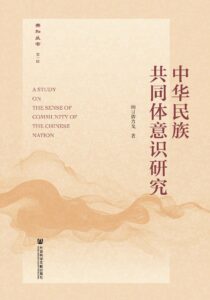
Naran Bilik 纳日碧力戈
Social Sciences Academic Press, 2024.
Reviewed by: Nishant Dilip Sharma (PhD Candidate, O.P. Jindal Global University)
In the years since “铸牢中华民族共同体意识” (zhulao Zhonghua minzu gongtongti yishi; “forging a strong sense of community for the Chinese nation”) was codified in the Party Constitution in 2017, there has been a noticeable surge in policy-adjacent scholarship echoing the designation of this agenda as the mainline of ethnic work. Within the echo chambers of these policy-adjacent scholarship, Naran Bilik presents his unique voice in his book 中华民族共同体意识研究 (A Study on the Sense of Community of the Chinese Nation), through an interdisciplinary approach that makes the case for viewing community as an interconnected whole, where plurality facilitates belonging through patterned interactions, rather than mere policy rhetoric.
The book takes readers through a journey moving from words to worlds: a longue-durée account of intermingling, linguistic embedding, cultural exchange, economic interconnection, and political unification that render plurality governable and intelligible as co-belonging. Though the book does occasionally fall into the cadence of policy-adjacent writing, it does so while warning that policy slogans can easily become formalistic, empty, and ornamental. Bilik reframes the teleology as civilizational reasoning, treating minority-majority interactions as shuangxiang zhulao 双向铸牢 or “two-way forging,” effectively translating a political imperative into a durable system of inter-recognition and shared participation.
This inter-recognition is brought out through examples from various disciplines like philology, ethnography, linguistics, ecology, and semiotics. While this breadth comes at the cost of methodological rigor, Bilik compensates for it through metaphors that serve as philosophical totems of the “consciousness.” One such metaphor is that of a dragon, presented not as a mere mythical beast but as a ‘integrative innovation’ (zonghe chuangxin 综合创新), a multi-source cultural synthesis whose san ting jiu si 三停九似 (“three segments, nine resemblances”) and tongtian shenshou 通天神兽 (“heaven-reaching divine beast”) imagery is said to symbolize an ethos of inclusive plurality. This pivot from the dragon metaphor to autopoiesis in theorizing Zhonghua is the hallmark of Naran Bilik’s unique voice, allowing the book to exceed the echo-chamber iterations that otherwise structure much policy-adjacent writing.
Bilik’s conceptual wager appears clearest when he aligns this autopoiesis with structuration theory. By aligning both, he attempts to mitigate an inherent structural tension of the book: although the narrative arc gravitates toward civilizational convergence, it remains driven by politically organized projects of ethnic work. The author addresses this tension by framing autopoiesis through a structuration mechanism in which the “environment,” arguably an environment of governance, is recursively produced. This move makes the tension less contradictory and more complementary, taking readers to the author’s conclusion, albeit with leaps. In the final chapter, the text takes another leap towards what could be perceived as “universal particularism,” extending a domestic frame to the global stage with the familiar slogan of “Community with a Shared Future for Mankind.” In all, this book shines as a medley of multidisciplinary scholarship, making sense as a whole, even when the causal pathways remain vague.