
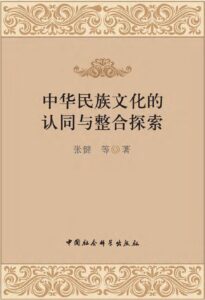
Zhang Jian et al. 张健 等 著
China Social Sciences Press , 2023.
Reviewed by: Raj Gupta (PhD Candidate, Jawaharlal Nehru University)
The integration of ethnic minority identities into the broader construct of a Zhonghua minzu 中华民族 (Chinese Nation) identity is an important cultural and political project in contemporary China. The integration involves preserving diverse local customs and heritage. But in some cases, it also represents a strategic imperative for national security and border stability, as elucidated in this book. The book Zhonghua minzu wenhua de rentong yu zhenghe tansuo 《中华民族文化的认同与整合探索》 (Exploration of the Identity and Integration of Chinese National Culture) provides a rigorous, albeit state-centred, theoretical roadmap for this process, using the Lisu people (傈僳) of the China-Myanmar borderlands as a primary case study. Published by Zhongguo shehui kexue chubanshe 中国社会科学出版社 (China Social Sciences Press) in 2023, this scholarly work is authored by Prof. Zhang Jian of Yunnan University’s School of Marxism and his colleagues. The book frames its research within the political backdrop of the Central Ethnic Work Conferences (2014 & 2021). Through the study of the Lisu people, the text explores the dialectical relationship between ethnic distinctiveness and national political destiny.
The book is divided into substantive theoretical and empirical sections. It begins by drawing upon the “Pluralistic Unity” framework as well as the metaphor of Chinese culture as the “trunk” and ethnic cultures as the “branches” and “leaves”. Chapter one examines the mechanisms of cultural identity formation through the Primordialist and Constructivist frameworks. It analyses how, as a response to modernisation and globalisation, identities evolve by strengthening, weakening, or assimilating. The chapter also emphasises the necessity of harmonising Lisu cultural identity with the broader Chinese national identity for maintaining border stability and enhancing China’s cultural soft power. Chapter two traces the Lisu people’s evolution from the ancient Di-Qiang group to their integration into the modern Chinese nation-state. It maps their migration through the Tibetan-Yi Corridor to the Nujiang river basin and analyses the impact on them during the Yuan, Ming, and Qing dynasties through the tusi system (土司制度) and the gaitu guiliu policy (改土归流). The section on the post-1949 era examines how state identification, regional autonomy, and “Direct Transition” policies (zhijie guodu zhengce “直接过渡”政策) have solidified the Lisu people’s dual cultural identity within the Chinese nation.
Chapter three moves towards empirical sociological research and presents data from fieldwork across Lisu settlements in Nujiang, Diqing, Lijiang, and Sichuan. It examines the manifestation of Lisu identity through material and spiritual culture. It highlights the vitality of the Lisu language and the syncretism of Christianity with indigenous traditions like the Kuoshi Festival and the Sword Ladder Festival. Through quantitative questionnaire surveys, the chapter measures identity metrics and establishes that Lisu respondents possess a high degree of political identification with the Chinese state and the Communist Party of China. While these findings are significant, the potential influence of social desirability bias must be considered, given the sensitive political context of the borderlands.
The last three chapters investigate the practical mechanisms, internal dynamics, and theoretical pathways for harmonising Lisu and Chinese identities. Chapter four categorises the construction of identity into distinct modes such as government-led, elite-driven, and inheritor-disseminated. It analyses their practical effects such as the synergistic interaction between ethnic tourism and folk customs. Chapter five deconstructs the complex forces at play, identifying tensions arising from globalisation, the spread of Christianity, and cross-border impacts, while juxtaposing them against the motivating forces of regional autonomy and the “mutual embedding” of ethnic groups. Chapter six elevates the discussion to a macro strategy by proposing a three-dimensional integration framework to guide the construction of a shared spiritual home through the concerted efforts of the Party, elites, and the masses.
Overall, this book is a significant case study of the dialectical relationship between ethnic particularity and national universality in the Chinese context. It meticulously analyses Lisu people’s trajectory. And in doing so, it argues that ethnic and national identities function as mutually reinforcing components of a ‘pluralistic unity.’ Beyond its sociological scope, the work is particularly valuable as a window into contemporary statecraft. It illuminates the state’s strategies of addressing the complexities of cross-border ethnicity by fostering political allegiance through economic development, integrating religious practices into secular cultural tourism, and by leveraging Constructivist approaches to build a cohesive national identity that bolsters border security.