
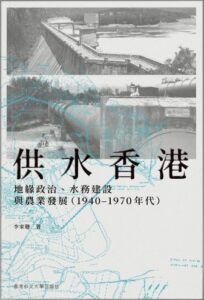
Nelson K. Lee 李家翹 著
The Chinese University of Hong Kong Press, 2025.
Reviewed by: Yijun Gai (PhD Candidate, University of Hong Kong and Southern University of Science and Technology)
Hong Kong’s development is often understood through a narrative of scarcity: a story of too many people on too little land, where reliance on mainland China for essential resources is portrayed as an unavoidable geographical destiny. However, in Supplying Water to Hong Kong: Geopolitics, Waterworks Infrastructure, and Agricultural Development (1940s-1970s) (《供水香港:地緣政治、水務建設與農業發展(1940-1970年代)》), Nelson K. Lee challenges this deterministic view and argues that “scarcity” was not merely a physical fact, but a governance challenge intertwined with Cold War geopolitics. By examining the British colonial government’s water management strategies from the 1940s to the 1970s, Lee structures his inquiry around two central puzzles: why did the colonial government vigorously build independent local water supply systems (through large reservoirs) while simultaneously negotiating for East River water? And counter-intuitively, why did local agriculture flourish despite the massive land appropriation required for these reservoirs?
The Geopolitics of Water Infrastructure: The book makes a significant contribution to the study of colonial governance by framing water infrastructure as a tool of political legitimacy. Lee demonstrates that the British colonial government’s pursuit of water autonomy in Hong Kong—through projects like Plover Cove and High Island Reservoirs—was a calculated “defensive” strategy to maintain political independence from mainland China. This analysis effectively employs the framework of “critical geopolitics,” showing that water infrastructure was not just about hydraulic engineering but also about defining the border and the relationship between the colony and the communist state.
Territorial Governance and the “Vegetable Revolution”: By analyzing Hong Kong’s territorial governance, Lee also offers an insightful explanation for its post-war agricultural boom. He highlights how, alongside the crucial farming skills brought by mainland immigrants, the colonial government’s strategic intervention—building irrigation systems to quell rural unrest from land resumption for reservoirs—fueled a “Vegetable Revolution.” This shift from rice to high-value vegetable farming contributed to both food security and rural stability. Yet, Lee critically argues that these were not benevolent concessions; the New Territories remained a “buffer zone” for the urban core, reflecting a persistent urban-rural imbalance in colonial priorities.
Supplying Water to Hong Kong is more than a history of infrastructure; it speaks profoundly to the present. Lee demonstrates that if the “land-scarce” Hong Kong of the 1960s accommodated both reservoirs and farms by balancing diverse interests for social stability, then today’s housing crisis may stem less from physical constraints than from a deficit in strategic vision and spatial justice. This historical perspective suggests alternative approaches to land and resource management, which necessitate learning from the lived experiences and voices of stakeholders beyond the Hong Kong government. While Lee’s analysis robustly details the colonial governing strategy, its reliance on official British archives limits insights into local farmers’ agency and the internal decision-making processes of mainland China—both crucial for understanding past alternatives and future possibilities.