We at the Harvard-Yenching Institute were deeply saddened to learn about the passing of Professor Stephen Owen on May 1, 2026. Professor Owen was James Bryant Conant University Professor, Emeritus in the Department of East Asian Languages and Civilizations at Harvard University.
In addition to serving as a mentor to many HYI Visiting Scholars, Professor Owen brought to HYI’s attention the importance of supporting less “favored”, less developed, or under-represented fields. He worked closely with the Institute to organize HYI’s first Harvard-based Training Program, on the topic of Comparative Literature.
The Institute’s then-Director, Elizabeth Perry, reflected on the development of the program: “During Tu Weiming’s directorship, Steve Owen and I served together for many years on an HYI faculty advisory committee that offered suggestions on how to improve Institute programs. I was impressed by Steve’s insistence that the Institute should do more to encourage scholarship beyond East Asian Studies, taking advantage of Harvard’s rich resources in European, American, and comparative studies. Soon after I became HYI Director, I sought Steve’s help — to ask if he might be willing to make good on his own recommendation by organizing a training program in comparative literature at Harvard for students and scholars from Asia. Steve was of course extremely busy with other commitments, but after only a bit of guilt-tripping he agreed! Together with his new colleague in comparative literature, David Damrosch, Steve recruited a cohort of outstanding young scholars from Asia for a year of study and research with HYI. His vision, dedication and generosity set the pattern for a series of highly successful faculty-led training programs in subsequent years that ranged in topic from Meso-American archeology to African Studies.”
During the 2008-09 and 2009-10 academic years, he brought to Harvard the first cohorts of junior scholars in the field for a research stay, guiding them with enthusiasm and dedication. The program helped achieve closer connections between Harvard faculty and HYI affiliates.
As Professor Owen wrote in his report on the program, “We decided, at least initially, to focus our attention on two kinds of fields: 1) those fields that tend to receive less support in East Asian universities, and 2) those fields that are conceived in ways that are substantially different from the way in which such fields are practiced in U.S. and European universities. In the first case we are building fields; in the second case we are building bridges between distinct practices within a single field. Comparative and world literature, with its infrastructure of diverse language and literature programs, serves both of these goals.”
As part of the program, the trainees attended two semesters of Harvard’s world literature course, and audited other courses based on interest. They also met with Professor Owen on a near weekly basis for free-ranging discussions. Summarizing the program’s aims, Professor Owen wrote, “By lectures (which show why some things might be interesting), by discussion, and by elementary bibliography we hope to link the Chinese humanities to the range of humanities offered at Harvard.” As Xiaolu Ma (2008-09) describes below, “The training program was nothing short of a transformative odyssey…the one-year program at Harvard challenged my preconceptions and revealed a vibrant landscape of diverse interpretations, each shaped by unique cultural backgrounds.”
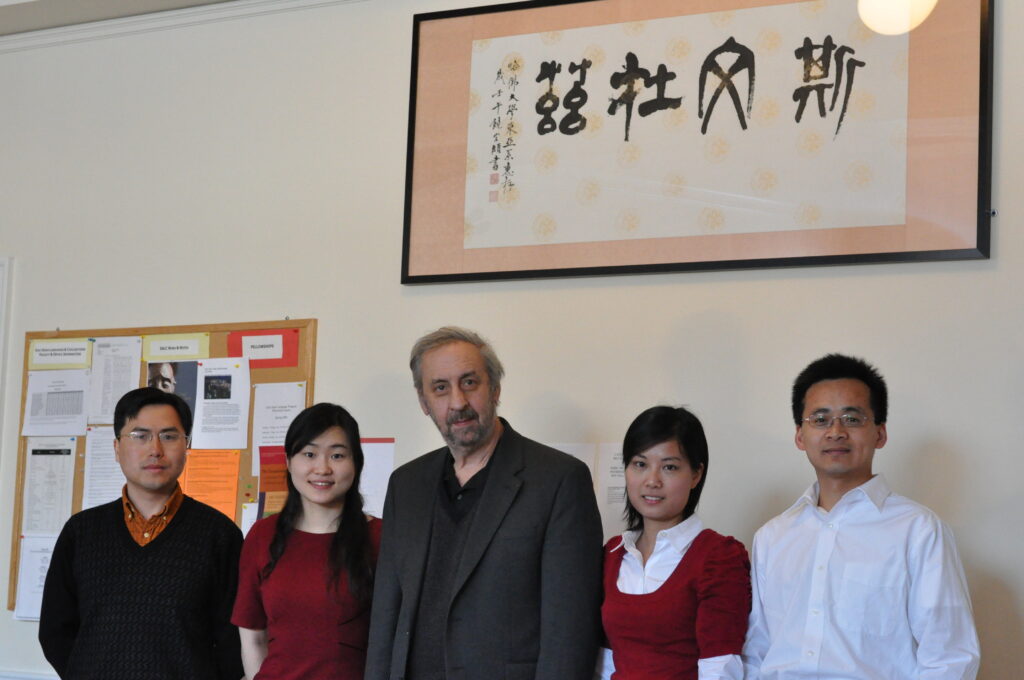
Professor Owen with the 2008-09 training program scholars
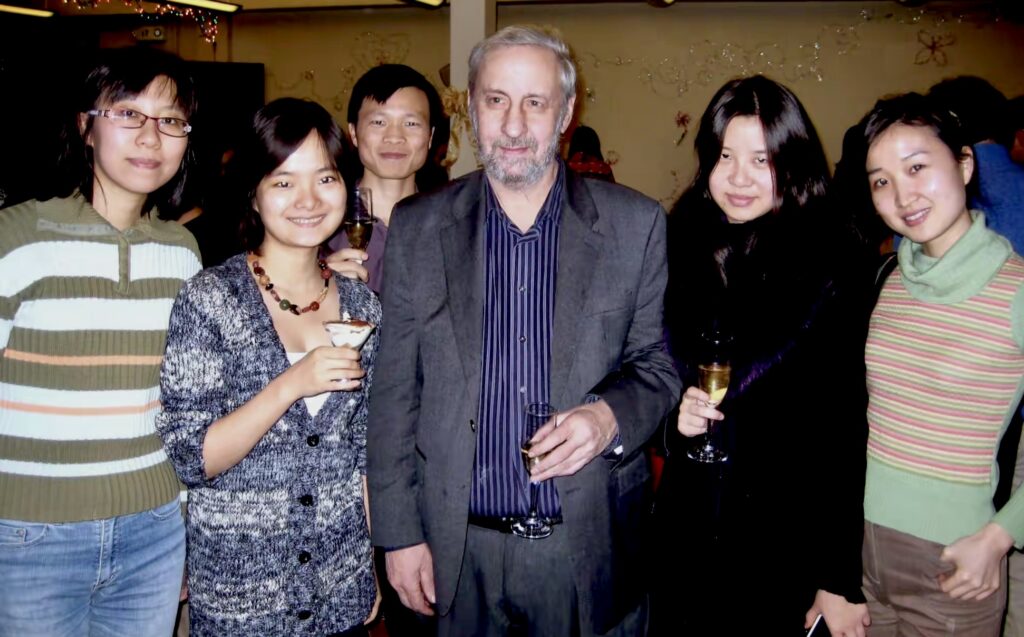
2009-10 Training Program scholars and fellows with Professor Owen
The following are tributes to Professor Owen from former HYI scholars and fellows in the Comparative Literature training program:
Bian Dongbo (2008-09): From 2008 to 2009, and again from 2014 to 2015, I had the privilege of visiting Harvard twice. The first time, I participated in the Comparative & World Literature Training Program at the Harvard-Yenching Institute; the second time, I was a visiting scholar in the Department of East Asian Languages and Civilizations at Harvard University. On both occasions, my host was Professor Stephen Owen.
Those two years of study at Harvard completely transformed my academic path. Previously, my work had focused primarily on Chinese literature. After returning from Harvard, however, under the profound influence of Professor Owen, I expanded my research to encompass Sinographic literature across East Asia in the premodern period, while also reexamining Chinese literature from a broader East Asian perspective. This transformation in my scholarly vision was entirely due to Professor Owen’s guidance.
Whether listening to his lectures in the classroom or conversing with him in his office and home, I always sensed the insight and elegance of a truly great humanistic scholar. He imbued literary studies with spirit and vitality; even his scholarship on Chinese literature possesses a poetic quality and a distinctive aesthetic beauty. He has made Chinese literature an essential part of the map of world literature, and he has also brought Chinese literature into the broader conversation of world literature.
Professor Owen’s achievements and contributions will surely endure in intellectual history, just as the great Chinese poets he studied—such as Du Fu and Su Shi—remain immortal. His wisdom will continue to shine for generations to come.
Liang Dandan (2009-10): I am deeply saddened by the recent passing of my dearest teacher, Professor Stephen Owen.
I studied as a Visiting Fellow at Harvard-Yenching Institute in the 2009-2010 academic year, the second year of the Comparative Literature program which Professor Owen directed. At that time, I was a PhD student in Comparative Literature at Fudan University, and had just completed an intensive Summer program of Western Classical and Medieval Culture at Fu Jen Catholic University in Taiwan.
During my year at Harvard, we met with Professor Owen almost every week. I audited the world literature course that he and Professor David Damrosch taught, as well as other courses in Western Classics. This experience transformed my initial impression of him: he was not only a brilliant scholar but also a brilliant teacher. His teaching was always enthusiastic, humorous, and filled with enlightening ideas. His ways of reading—always detailed and contextualized, always deep and broad—exerted an enduring influence on me. He also gave me generous encouragement in my studies of Western Classics, and provided warm and helpful suggestions on my dissertation on Confucian hermeneutics.
The memory of his vivid talk and warm smile lingers in my mind. I had always looked forward to meeting him again after so many years. Regret filled me when the sudden news made everything stop, frozen.
Perhaps the way to communicate with him is through the words and memories he left us, and through the spirit within them, which is forever with us.
Xiaolu Ma (2008-09): The 2008-2009 HYI training program was nothing short of a transformative odyssey. Before this enlightening journey, I was ensconced in the realm of comparative literature as interpreted through the lens of Chinese scholars. Yet, the one-year program at Harvard challenged my preconceptions and revealed a vibrant landscape of diverse interpretations, each shaped by unique cultural backgrounds—a revelation made possible by the illuminating guidance of Professor Stephen Owen.
I vividly recall the palpable excitement that enveloped our discussions after his world literature classes, our hearts racing with the fear of overlooking some profound insight he had shared. The thrill of traveling to his home in Newtown for late-night dialogues, where laughter intertwined with deep satisfaction, still resonates with me. Professor Owen’s extraordinary attention to detail and expansive knowledge of global literature left me in awe. As I grappled with my Master’s thesis in the spring of 2009, it was he who introduced me to Gaston Bachelard’s The Poetics of Space, a work that became instrumental in shaping my theoretical framework. To this day, I still wield its insights in my teaching on the concept of space.
While Professor Owen wisely warned us of the pitfalls inherent in the practice of comparative literature, he simultaneously unveiled its enchanting allure. His unwavering patience as he answered our myriad questions and soothed our frustrations, often drawing from his own experiences, was a testament to his dedication. I chuckle at his playful admonition not to question his linguistic prowess, but rather to ponder how many languages he has forgotten. In hindsight, I understand it now as a glimpse into the rich mosaic of cultures he has traversed, all of which inform his profound understanding of Chinese classical literature as an integral part of a larger world narrative.
Indeed, my year in the HYI program under Professor Owen’s mentorship was pivotal, guiding me toward my decision to pursue a PhD in comparative literature at Harvard. The standards he established have become my unwavering benchmark, a guiding light as I embark on my own research journey.
Jiang Tong (2008-09): I was saddened to learn of the passing of my teacher, Professor Stephen Owen. In 2008, he collaborated with the Yenching Institute on a Comparative Literature and World Literature program, and I was among the first cohort of visiting scholars (August 2008–June 2009). During that time, Professor Stephen Owen met with us every two weeks, engaging in wide-ranging conversations about scholarship and life. I also audited his courses on Comparative Literature and World Literature for one year.
On October 29, 2020, he gathered the eight visiting scholars of the program online, inquiring warmly after each of us and asking about our academic work. Little did I expect that it would be the last time I saw him.
Throughout his life, Professor Stephen Owen was devoted to teaching and research. He was a highly accomplished sinologist, endowed with a poetic sensibility, and dedicated to bringing Chinese classical literature to the Western world. In the past, I read his works in pursuit of knowledge; from now on, I will read them in remembrance. A fine teacher and true friend like him is irreplaceable. May he rest in peace.
Liang Zhao (2008-09) – Words as Communion, Literature as Self-Cultivation: In Memory of Professor Stephen Owen
On the morning of May 2nd, I was stunned to learn on social media that Professor Stephen Owen had passed away. A deep sorrow overwhelmed me, and tears welled up in my eyes.
From 2008 to 2009, I had the privilege of participating in the “Comparative Literature Training Program” led by Professor Stephen Owen. Sponsored by the Harvard-Yenching Institute, this opportunity allowed me to spend a year as a visiting scholar at Harvard University.
At that time, the program selected four scholars and graduate students from China, with Professor Owen personally conducting the interviews. I remember the night before my interview; I was almost entirely sleepless, my mind swaying between the trepidation of an examination and the exhilaration of meeting a world-renowned scholar. Long before our meeting, I had been captivated by Professor Owen’s scholarship through his translated works. I was profoundly impressed by his innovative perspectives, the depth of his close readings, and his poetic prose. When I finally met this world-renowned scholar the following day, his humility and erudite aura immediately put my mind at ease.
After arriving in the U.S., I audited the weekly “World Literature” course co-taught by Professor Stephen Owen and Professor David Damrosch. Titled “Writing Across Cultures: Literatures of the World”, this was a flagship General Education course at Harvard. The curriculum sought to break through the narrow lens of modern “national literatures,” reconfiguring five thousand years of literary tradition into a fluid cultural landscape.
After a year of auditing, I authored an article titled “What is ‘World Literature’? — A Brief Discussion on Harvard’s Undergraduate World Literature Course,” published in University Humanities Education, a journal hosted by the School of Literature and Journalism at Sichuan University. In the article, I argued:
The knowledge construction of “World Literature” at Harvard aligns with the ‘cosmopolitan’ ambitions of the institution and its scholars. This encompasses a social ambition—rooted in General Education—to “help students understand themselves and others as participants in a tapestry of cultural and religious traditions.” It also entails an aesthetic ambition that integrates diverse regional literatures into a unified aesthetic “world”. … This endeavor resembles an “imperial” construction, centered on Western canons while incorporating peripheral territories. Within this intellectual landscape, the ambition of scholars at America’s premier university is no longer merely to explain a specific regional tradition, but to integrate all cultural traditions into a universal aesthetic interpretation, thereby establishing their modern imagination of “World Literature”.
Concluding the article with a reflection on the domestic situation in China, I noted:
The discipline of Comparative Literature in China has evolved alongside the nation’s increasing integration into the global community. Since “Comparative Literature and World Literature” was officially established as a sub-discipline in 1997, many universities have begun re-evaluating the pedagogy of “World Literary History”. Scholars have noted that to bridge the current gap between “Eastern and Western literatures”, we must delve into the curriculum structure and its conceptual framework. This requires a fundamental rethinking of literary periodization, the intrinsic links between East and West, and the position of national literature within the global knowledge system.
Such discussions transcend mere knowledge organization or pedagogical technique; they demand that we cultivate a new historical consciousness and a mode of literary discourse rooted in our own traditions within the modern world. In other words, if “World Literature” exists, it must be a pluralistic one—varying according to one’s vantage point—yet each unique system carries its own inherent universal significance.
Today, I see these writings as my youthful attempt to synthesize the lessons I learned at Harvard with my own cultural roots, striving to harmonize a global outlook with a local heart.
Over the years, the research paradigms of “World Literature” have permeated comparative literature circles globally, while the “world” itself has undergone profound transformations. Looking back, the shifting global landscape is truly a cause for reflection. Though these writings might now seem intellectually idealistic, the desire to “cross borders” and perceive diverse cultures remains the guiding principle of my research and teaching today.
Upon returning from Harvard, I authored several papers on Chinese and foreign ethnic literatures. These were later compiled into a collection titled “Literary World and Ethnic Writing” (China Social Sciences Press, 2018).
Studying under Professor Stephen Owen profoundly taught me that for him, literary research was never merely an act of knowledge construction; it was a way of being, an existence intertwined with his personal passions and vitality. Whether lecturing on world literature or Tang poetry, he often wore an expression of pure, childlike wonder. Whenever he touched upon a subtle turn of wit or a hidden nuance in the text, he couldn’t help but break into a knowing smile. In those moments, I felt he was using words to pierce through time and space, capturing the elusive traces of a poet’s thoughts from a thousand years ago. His meticulous, word-by-word reading of Wang Wei’s (王维) Wangchuan Ji (《辋川集》) with his graduate students felt like a form of patient spiritual discipline through text. He once remarked: Art students spend hours contemplating a single masterpiece; why shouldn’t literary researchers savor a poem with the same devotion, line by line?
To read and interpret poetry requires a limpid aesthetic synesthesia and spiritual composure. Both Professor Owen and his wife, Professor Tian Xiaofei, have demonstrated through their works and classrooms a paradigm of living with literature: they treat literary works as independent living spaces, observing how poets construct these realms to dissolve the decay of physical time. In this process, the researcher projects their own life experiences into the close reading, achieving a spiritual communion with historical traces.
As I type these words, it suddenly strikes me that those days of walking and learning in the town of Cambridge were nearly twenty years ago. In the intervening two decades, Professor Owen completed the monumental task of translating the complete poetry of Du Fu (杜甫). Whenever I read news of his academic endeavors, my mind always returns to the unchanging red bricks and green trees of Harvard Yard.
Though Professor Owen has departed, his dialogue across time with the great souls of Chinese literature, and the vibrant poetic spaces he opened, will be like Du Fu’s immortal line: “The rivers flow on forever, unceasing through the ages (不废江河万古流).” His legacy will transcend eras, eternally nourishing those who follow.