
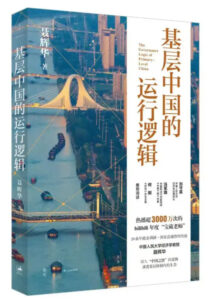
Nie Huihua 聂辉华
Shanghai: Shanghai People’s Publishing House (上海人民出版社), 2025.
Reviewed by: Raj Gupta (PhD Candidate, Jawaharlal Nehru University)
In the book titled Jiceng Zhongguo de yunxing luoji 《基层中国的运行逻辑》(The Governance Logic of Primary-Level China), Prof. Nie Huihua of Renmin University of China sets out to explain how China actually works at its base level. His starting point is that more than 90 percent of Chinese people do not live in the first-tier coastal cities, so to understand the country you have to understand the county, the township, and the village. The book reads grassroots (基层) governance through the combined lens of organisational and political economy, and arranges its analysis into three nested levels: national governance, primary-level governance, and individual choice. Its central tool is a dual-equilibrium framework of internal and external conflict. It notes that the governance that prizes stability must continually weigh internal threats against external ones, leaning toward centralisation or decentralisation as the balance shifts.
Chapter one describes the framework of national governance. It contrasts vertical functional lines tiao tiao (条条) with territorial blocs kuai kuai (块块) and traces how their balance has shifted through different dynasties. Nie explains administrative geography and shows that provincial borders encode the old bargains between centre and locality. He revisits the popular maxim that “the imperial power does not reach below the county-level” (皇权不下县) as a trade-off between local vitality and central order. Chapter two turns to rank. Nie argues that alongside markets and prices, administrative rank is a primary mechanism for allocating resources. He maps a pyramid of cities from the municipalities down to the counties, to show how higher tiers draw resources first.
Chapters three and four move inside grassroots organisations. Chapter three reads like a power inventory of local chiefs, centred on the county Party secretary, whom Nie calls the most powerful person in the county. He traces how that authority flows through the Party standing committee and control of personnel. Chapter four turns to the capillaries of the state i.e., the lowest units that carry policy to households. Nie separates the urban street office (街道办) from townships and from residents’ committees, and argues that a system of political contracting converts limited offices into nearly unlimited responsibility. The chapter closes with young township civil servants and with village cadres, who, as he points out, are not formally officials at all. Chapter five portrays the local chief inside a pressure-type system, where responsibility cascades downward and is amplified at each level. Drawing on Zhou Hao’s documentary The Secretary, which trails a county Party secretary through his meetings, guests, and banquets, Nie sorts the secretary’s daily work into four types, and elsewhere names his three hardest burdens: maintaining stability, attracting investment, and managing debt. Chapter six asks how such officials are motivated, and finds that promotion counts for more than pay.
The final chapters widen the frame to development and the region. Chapter seven catalogues the dilemmas of grassroots governance: the scramble to attract investment and the resulting tangle of government-business relations, the rise and limits of land finance, and local debt as a grey rhino. It ends more hopefully, with rural e-commerce and Taobao villages reviving shrinking counties. Chapter eight takes up regional coordination, while also presenting a government-business relations index across some 290 cities, in which the decisive divide runs east to west, along the Hu Huanyong line, rather than north to south.
Throughout, Nie pairs economic theory with materials such as documentaries, satellite land monitoring, his own empirical studies and even dinner-table conversations. It is written for students and general readers as much as for specialists. The result is an accessible, example-rich account that ties China’s macro institutions to the daily texture of grassroots life, and returns, at the close, to the author’s ideal of joint governance from top and bottom (上下同治).