
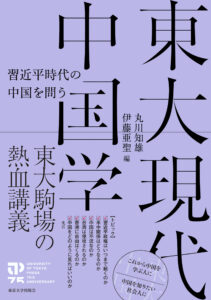
Tomoo Marukawa & Asei Ito (Eds.) 丸川知雄・伊藤亜聖編
Tokyo: University of Tokyo Press, 2026.
Reviewed by: Yuki Mikiya (PhD Candidate, Keio University)
Marukawa’s blunt preface says China may even have regressed politically; the subtitle asks whether China should continue on its present course under its current state structure. The fourteen lecture-based chapters do not converge on a single argument. The tension between this frame and the chapters’ varied approaches is revealing. Across five parts (politics and international relations; Hong Kong, Taiwan, and ethnic-minority issues; economy; society; and research methods), the book maps how one University of Tokyo group studies contemporary China without claiming to represent Japanese China studies as a whole. A productive reading asks what becomes visible when these approaches are set beside one another. Read together, the chapters suggest that no single evidentiary practice is adequate for understanding Xi-era China.
In the economy and society chapters, contributors test claims about the reach of the Chinese state against sectoral institutions and lived experience. Tomoo Marukawa’s chapter on industrial policy resists attributing sectoral development to state planning alone: policy failure, private firms, and foreign capital interact differently across industries. Fumiki Tahara’s study of a Gansu village complicates linear narratives of urbanization by tracing household strategies that combine farming, migrant labor, and residence in the county seat. Li Hao’s chapter on the Communist Party supplies the political counterpoint: Xi’s personalization is built upon, and erodes, the institutional resilience that carried the Party through earlier crises. Read together, these chapters portray central intentions as real but repeatedly refracted by institutions, markets, and household strategies.
The methodological concern becomes explicit in Part V. Asei Ito’s chapter on “hybrid data” surveys work combining conventional and firm-level, textual, geospatial, and other digital data while stressing the importance of research questions, data construction, disciplinary training, and field judgment. From a historian’s perspective, Motoya Nakamura argues that text-mining analysis is persuasive only when source criticism and established historical knowledge constrain its interpretation. Citing Kevin O’Brien, Ito warns that increasingly precise studies can remain isolated “islands of research” unless reconnected to larger questions about China. Together, the two chapters show how different forms of evidence can check one another.
The volume grew out of a 2025 University of Tokyo lecture course, the third book produced through this lecture-series format, and its lecture origins remain visible: questions, evidence, and modes of inference vary sharply. The editors do not supply a cross-chapter synthesis, leaving readers to construct one. Fourteen contributors from one university cannot represent China studies across Japan, but the volume offers a clearly situated view of one university-based research community.
Beyond Japan, the collection is valuable not as a national template, but as evidence of one research community combining source-critical history, sectoral knowledge, fieldwork, and new data. Japan’s long traditions of text-critical scholarship, its geographic proximity to China, and the two countries’ complex historical relationship shape the questions visible here without defining a single national method. As some forms of access to China narrow, this situated combination brings a different perspective to debates centered on research from universities and research institutes in China, Europe, and North America.