
Original images held by the Harvard-Yenching Library of the Harvard College Library, Harvard University
Introduction written by Ana Mundaca (A.M candidate, Regional Studies in East Asia (RSEA) Program, Harvard University)
A guru, fully clad in fuchsia, directs a Russian orchestra. Shirtless men float in a pool, breathing in high-concentration oxygen pumped into plastic containers placed above their heads, before submerging themselves underwater for as long as possible (the winner lasts 12 minutes and 33 seconds). A small radio-controlled blimp is flown around a living room: the blimp is available for purchase as a kit, which includes a motor, propellers, noise suppressor, and a complimentary visit from a staff member to fill their balloon with helium gas. Interspersed between the magazine pages that house these images are dozens upon dozens of photographs of men and women floating in mid-air as they meditate.
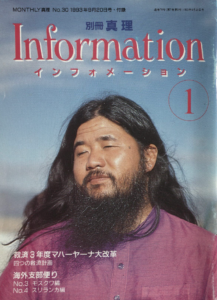
The above seemingly unrelated images are in fact linked together as part of Harvard-Yenching Library’s Aum Shinrikyo Collection. The Aum Shinrikyo Collection refers to an extensive set of books, magazines, and documents predominantly published by Aum Shinrikyo, a Japanese new religious movement and doomsday cult led by Asahara Shoko, and most well known for their sarin gas attacks in the Tokyo subway system on March 20th, 1995. The Aum Collection is mostly, though notably not exclusively, composed of Japanese language material. English-language materials compose the second-largest group of items, followed lastly by those available in Russian. The trilingual nature of the collection hints at how these materials arrived at the Harvard-Yenching Library. The purview of Aum’s activities did not stop at the borders of the Japanese archipelago. Aum conceived of its mission of salvation on a global scale, an inclination visible across Aum’s materials. Many of the back covers of Aum’s lifestyle magazine Shinri ran advertisements for Aum’s nightly radio broadcast; a recurring one features a depiction of the globe tuning in to Asahara’s broadcasts using headphones. Notable too in these advertisements is the logo for the radio show itself: a globe, topped by what appears to be a stupa broadcasting radio waves. Dozens of magazine articles run in Shinri, as well as across other magazines published by Aum, such as Enjoy Happiness and Mahayana, similarly showcase the group’s global focus by featuring articles on their trips to India, Sri Lanka, and Russia. The term “global” itself may be too constrained when referring to Aum’s worldview: Asahara often lectured on aliens (see “Asahara Shoko’s World” below) and is often depicted throughout the Aum Collection as a being who can travel through outer space.
But before turning to the rest of the universe, Aum had to begin with the planet Earth (which they referred to as a part of “the gross world”). Beyond the dozens of branches across Japan, Aum founded many international branches, primarily in Russia. With offices in Moscow, St. Petersburg, Vladivostok, and at least 6 other cities across the state, Russia was home to Aum’s largest international presence.[1] Beyond Russia, Aum also set up offices in Bonn and New York, the origin point for Harvard-Yenching Library’s current collection. Nearly all items within the Aum Collection are stamped with the address of Aum’s American outpost on East 48th Street: it appears that these items made their way to the library after the cult closed its American branch following the gas attacks of 1995, though more investigation into exactly how that happened and who thought to send the materials that now make up six large file storage boxes in the Harvard-Yenching archives is necessary. Thanks to recent efforts of the Special Collections staff, the six boxes of the Aum Collection are now fully indexed and organized by genre, author, and language.
How necessary that indexing is indeed, for a collection so vast, plentiful, and rich; one so extensive that it outsizes that of even Japan’s National Diet Library in its holdings of Aum periodicals and other primary source materials. And be careful searching for these materials in Jimbocho or any of Japan’s other used book markets: one early researcher into Aum’s manga was followed and questioned in Tokyo by police after searching for a copy of Aum’s first manga Spirit Jump (an experience he would most likely not have at the Harvard-Yenching Library, dependent on the mood of the special collections staff, if he were to come read it as box 3 item 9 of the collection).[2]
It is difficult to think of a scholar from any discipline who would not find some source within the Aum Collection directly related to their field of study. This fact speaks not only to the breadth of Harvard’s holdings of Aum’s material but also to the wide range of publication activities undertaken by Aum, attested to perhaps no better or more directly than by Harvard-Yenching’s Aum Collection. Many of the works are attributed to Asahara Shoko himself, but others are authored by collective authors within the organization such as the New Medical Research Society (Atarashii Iryō Kenkyūkai), University of Tokyo Aum Shinrikyo Student Group (Ōmushinrikyō Tōdaisei gurūpu), or Aum MAT Studio, Aum’s in-house animation and illustration group. Below are some of the most striking and unique holdings of the collection, with some brief context to highlight their intrigue, singularity, and the sheer variety of objects within the Aum Collection.
Asahara shoko no sekai (Asahara Shoko’s World) (Box 1 Items 1-20)
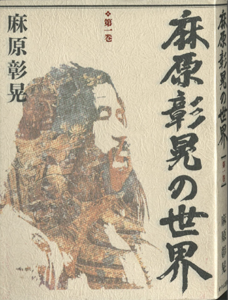 Asahara shoko no sekai is a 20-volume book series attributed to Asahara Shoko, composed primarily by his interviews, sermons, and autobiographical accounts. Earlier volumes contain an assortment of Asahara’s writings on a wide variety of topics, including but not limited to preschool education, astral music, UFOs and aliens, and the importance of a healthy diet to the mind (see “Enjoy Happiness” below to see what a healthy diet looked like to Aum.) Later volumes are typically divided by the theme denoted on the cover. Volume 8 has a special section featuring Aum students who attained supernatural abilities through spiritual practice with Aum. Volume 9 primarily revolves around Aum’s expedition to India, while Volume 17 details the group’s trips to Russia and Sri Lanka. Volume 20 details Asahara’s visions of the end of the world. The title page reads: “Asahara Shoko’s Chilling Prophecy… Will you survive humanity’s final war?”
Shinri (Truth) (Box 4 Items 6-12)
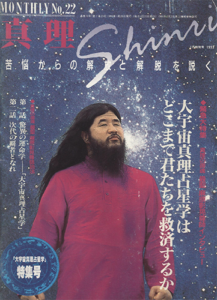 Of Aum’s magazines in the collection, Shinri provides the most succinct look into both the beliefs and activities of the group. Shinri was published to keep Aum followers (and potential recruits) informed of the activities of Aum’s leadership while highlighting what Aum activities they themselves could participate in. Shinri thus contains advertisements and articles that document many minor endeavors undertaken by Aum that are not commonly covered in scholarship on Aum. One such example is that of Sattva Foods: soy sauces, honey, rice crackers, nuts, miso, and other pantry staples whose karma had been enhanced by passing electromagnetic waves derived from recordings of Asahara’s speeches through the food products before packaging. These advertisements are interspersed between articles highlighting other activities occurring within Aum, such as the visit of the Russian orchestra, Chyren, to Japan to perform music composed by Asahara, international trips taken by Aum’s leadership, and the group’s investment into animated and illustrated media as new forms of promoting Aum. Both Shinri and Enjoy Happiness can be at least partially studied by English speakers, as the illustrations alone allow insights into many facets of Aum’s belief systems, cosmology, and activities.
Enjoi Hapinesu (Enjoy Happiness) (Box 4 Items 13-15)
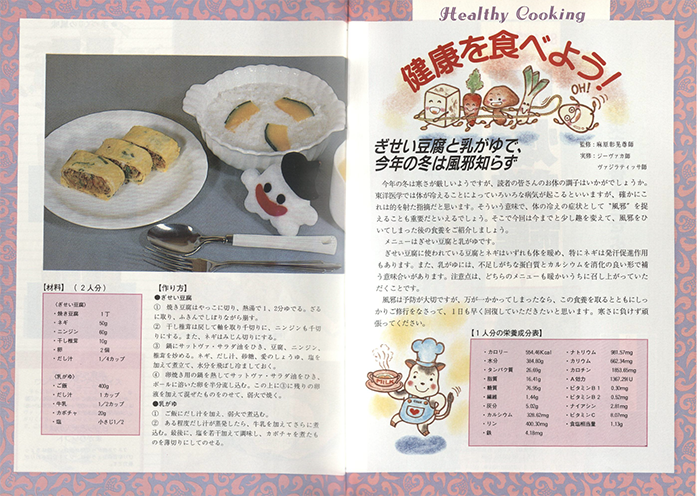
Enjoy Happiness was a monthly lifestyle magazine released by Aum that mainly focused on displaying the ways in which Aum beliefs, products, and practices could be integrated into everyday domestic life. There were many regular sections of Enjoy Happiness that are published with each iteration of the magazine, such as English in Dharma, a section meant to explain English terms related (but often not related ) to relevant scripture; Healthy Cooking, which highlighted a recipe that remained in accordance with Asahara’s views of what constituted a healthy diet; EH Member’s Square, where readers could submit reflections, questions, and illustrations; and Monthly Highlights, a short news section that reported on Aum’s larger activities (this section was significantly shorter than the news sections of Shinri.) Unique to Enjoy Happiness was the length and breadth of the monthly Guide to Aum’s Publications section at the back of each issue. While nearly all publications released by Aum contained a section advertising other magazines and books published by Aum, none had a section so lengthy and detailed than that of Enjoy Happiness, unless it a special catalog insert accompanied the text (volume 11 of Asahara Shoko’s World contains such a promotional insert). Divided loosely by genre, the guide prominently displayed the wide range of topics on which Aum published.
Metsubō no hi (Destruction Day) manga (Box 3 Item 10)
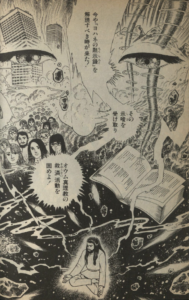
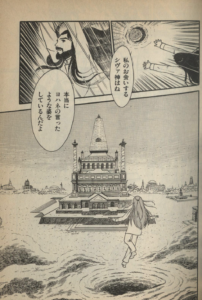 While Aum’s most prolific manga is likely Spirit Jump—a three-volume series detailing the stories of how various Aum followers joined the group, and the success they found therein—its lesser-known cousin Metsubō no hi provides a rarer glimpse into Aum’s worldview. The manga adaptation of Asahara Shoko’s Metsubō no hi (Box 2 Item 7) displays, through stunning illustrations, Asahara’s conception of destruction day, the prophesied moment when the world will end and Asahara and Aum’s most devoted followers will ascend beyond this realm. Like Aum’s magazines, Aum’s manga are fairly accessible to English speakers, as what is most striking about Metsubō no hi is its illustrations and imagery. Visible too in this work is the eclectic nature of Aum’s belief system. Scenes from the New Testament’s Book of Revelation are quoted and depicted extensively alongside drawings of Asahara meditating or otherwise moving through outer space.
  Once Asahara ascends on destruction day, he approaches a heavenly building floating in the clouds. The building appears to draw heavily from the Roman architectural tradition. What appears to be a large Egyptian obelisk (an architectural motif often appropriated by the Romans) is surrounded by four columns with a twisting pattern that resembles Trajan’s Column. These structures sit perched upon a set of arches that frame small statues, reminiscent of the original design of the Colosseum. Simultaneously, the general shape of the building resembles that of a Tibetan stupa. Metsubō no hi is a bit rarer than Spirit Jump and is more difficult to find in used bookstores or archives, part of what makes it a true gem of the collection.
Disaster Approaches the Land of the Rising Sun (Box 6 Item 5)
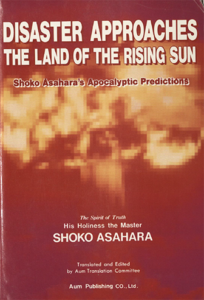 Out of all the English texts available in the collection, Disaster Approaches the Land of the Rising Sun provides the best introduction to Aum’s rising paranoia about the outside world. For readers limited to the English-language portions of the collection who are looking to understand Aum’s religious belief system, it would be better to turn to Aum Supreme Truth (Box 6 Item 6), a short pamphlet meant to introduce the public to the group and its belief system, or Supreme Initiation (Box 6 Item 1), the English translation of Asahara Shoko’s Inishiēshon (Box 5 Item 11), perhaps the most widely promoted and referenced text within Aum’s periodicals, manga, and advertisements in the collection. But to understand the ways in which Aum’s belief system extended beyond their spiritual practice and suffused their mode of engaging with the world beyond the walls of their offices and compounds—the same mode that would eventually led to their terrorist attacks in 1995—Disaster Approaches the Land of the Rising Sun is instructive.
 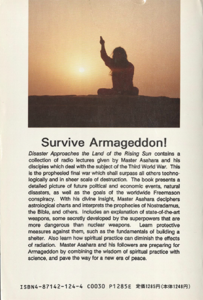 The text is a collection of Asahara’s radio broadcasts. Within the text, a new Russian “earthquake weapon” is pointed to as the cause of the 1995 Hanshin earthquake, a destructive earthquake that decimated many parts of Kobe and left approximately 5,000 people dead. According to Asahara, the Hanshin earthquake was merely the beginning of a long period of destruction at the hands of large world powers. The groups paranoia regarding surveillance is also displayed as they include photos they took of American fighter jets flying near their base; apparently, this was part of the American government’s campaign against Aum. Aum’s increasing paranoia and hostility towards the outside world, visible in this text, is often pointed to in scholarship as a precursor to the attacks of March 20th, 1995.
Sonshi ni kiku (Asking the Master) (Box 1 Items 24-25)
Sonshi ni kiku is as unique as it is derivative, a puzzling contradiction that is found in many works throughout the Aum Collection. There is very little information within Sonshi ni kiku that is new. All charts within the text, as well as teachings from Asahara, can be found in other publications released by Aum. What is novel about the text is its organization and visual style. Other charts within Aum’s publications tend to rely on scientific imagery in their presentation. Detailed anatomical charts document the ways in which Aum practice affects the body; sine waves with equations explain the karmic potential of Asahara Shoko’s soul over a century; three-dimensional models represent Aum’s conception of the different realms of existence. What is striking about Sonshi ni kiku is that the same information presented with technical precision in other texts is communicated here through handwriting. All charts within the text are labelled by hand. The chart used to indicate the location of chakras throughout the body is simplified and hand drawn. A cartoon version of Asahara’s face sits above each of his dialogue lines; the patient, friendly face beams as the inquisitive students bring their questions and qualms to him. Throughout the text, five recurring cartoon renderings of Asahara are used, each with slightly different facial expressions. With each of Asahara’s interview answers, one of the cartoon versions of his face floats above his quoted response. It is as if his icon is alive, or at the very least, engaged with both the curious students and the reader.
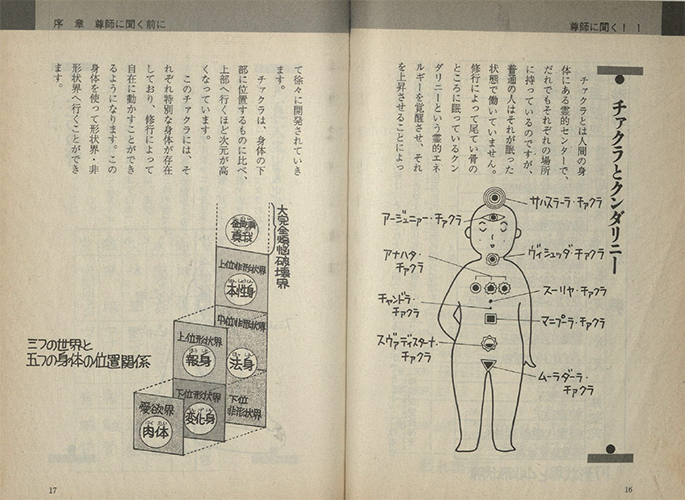
In the same fashion that Metsubō no hi was adapted into a manga, Disaster Approaches the Land of the Rising Sun was a repackaging of Aum’s radio broadcasts, and Shinri and Enjoy Happiness contained many of the same advertised products and articles presented in a slightly different way, Sonshi ni kiku functions like an adaptation of information already present and circulating within Aum’s other materials. This pattern indicates an understanding within the publishing arm of Aum that information alone is not what captures people’s attentions but that its presentation—its appearance, its tone, the medium through which it is received—informs people’s openness to and experience of a given text.
In an age where the detrimental effects of the widespread use of artificial intelligence and algorithmic social media platforms on perceptions of truth and knowledge are discussed widely, the idea that the way we receive information conditions our response to it may not seem novel. It is important to recognize that Aum’s conception of media was novel and singular. In several respects, it prefigured contemporary discussions of the ways in which media alter the ways people perceive and interpret reality.
There are other aspects of Aum’s trajectory that parallel certain alarming patterns in our present-day, digitally interconnected moment. Aum began as a religious group with a hope of global salvation, one it thought would be possible to achieve by connecting to the whole world through leveraging radio, digital, and print media networks. Within less than a decade, the group had turned paranoid, anti-social, and ultimately murderous. A group that initially understood media networks as technologies of global connection and collective salvation ultimately came to interpret the same networks through a paranoid and exclusionary lens. How chilling, to consider the violence to which that worldview ultimately led them; how sobering, to sense the echoes of that logic in our own contemporary mediatized world.
Acknowledgement: The author wishes to thank Yuzhou Bai, Special Collections Librarian and Archivist at the Harvard-Yenching Library, for his work reorganizing and indexing the Aum Collection.
[1] U.S. Senate Governmental Affairs Permanent Subcommittee on Investigations, Global Proliferation of Weapons of Mass Destruction: A Case Study on the Aum Shinrikyo, staff statement, October 31, 1995, 1.
[2] Schodt, Frederik L. 1996. Dreamland Japan : Writings on Modern Manga. Stone Bridge Press.