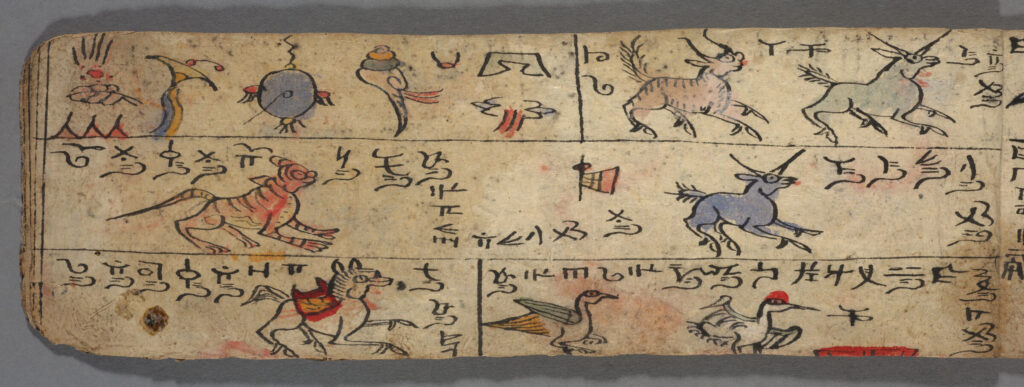
Wooden slats paintings, called khua³³biə²¹ in the Naxi language.
Original images held by the Harvard-Yenching Library of the Harvard College Library, Harvard University
Written by Li Xiaoliang 李晓亮 (Southwest University, China)
The Harvard-Yenching Library houses a total of 621 Dongba 东巴 manuscripts, comprising 598 original volumes and 23 physical facsimiles. Written in the Naxi 纳西language and employing Dongba script, a unique pictographic writing system of the Naxi ethnic group of southwestern China comprising more than two thousand glyphs, these manuscripts record the Naxi people’s customs, rituals, and artworks. The collection stands in high esteem within academic circles, owing to its remarkable combination of five key merits: antiquity of origin, exceptional state of preservation, elegant calligraphic artistry, exquisite illustrative details, and comprehensiveness of content.
In terms of provenance, 569 original volumes and 23 physical facsimiles are traceable to Joseph F. Rock’s former holdings, while the remaining manuscripts have uncertain origins. In terms of content, the entirety of the collection is referred to as “Naxi ritual texts.” When it comes to the scripts employed, one volume is composed entirely in Sanskrit, one volume is composed in Sanskrit and Dongba script, three volumes are composed in Geba script, and others are composed either in Dongba script alone or in a bilingual combination of Dongba and Geba 哥巴 scripts.
Geographically, the Dongba manuscripts at Harvard were primarily compiled from three key regions: the vicinity of Lijiang City, the northern mountainous areas of Lijiang, and the Ruka area straddling the Sichuan-Yunnan border.
Chronologically, most of these manuscripts date to the period spanning the late Qing Dynasty and the early Republican era. As for the scribes, the majority of the manuscripts were transcribed by renowned ritual specialists (Dongbas) such as Dong Zhi 东知, He Hong 和鸿, He Xueli 和学礼, Dong Fa 东发, and He Huating 和华亭.